
U.N. and DOT/CTC Cylinder Marking Examples
DOT/CTC High-Pressure Cylinder Markings
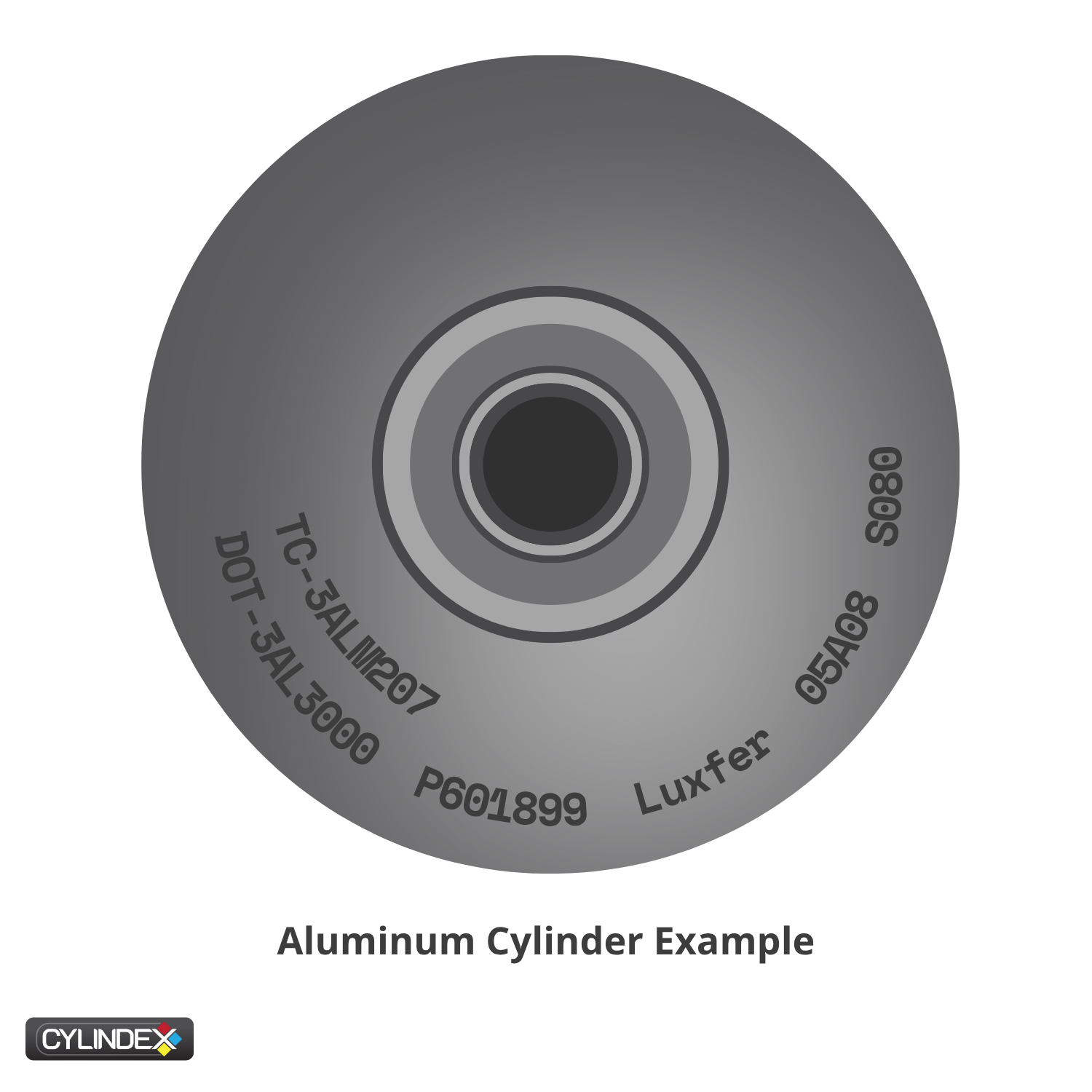
“TC-3ALM207”
TC: Transport Canada Compliant
3ALM: Material Type Aluminum
207: Service Pressure in BAR
“DOT-3AL3000”
DOT: Department of Transporation (U.S.A) Compliant
3AL: Material Type Aluminum
3000: Service Pressure in PSI
“P601899”
Manufacuter Assigned Serial Number
“Luxfer”
Manufacturer Name
“05A08”
05: Month of Manufacture
A: Marl of Independant Inspector
08: Year of Manufacture
“S080”
Cylinder Size Cubic Ft
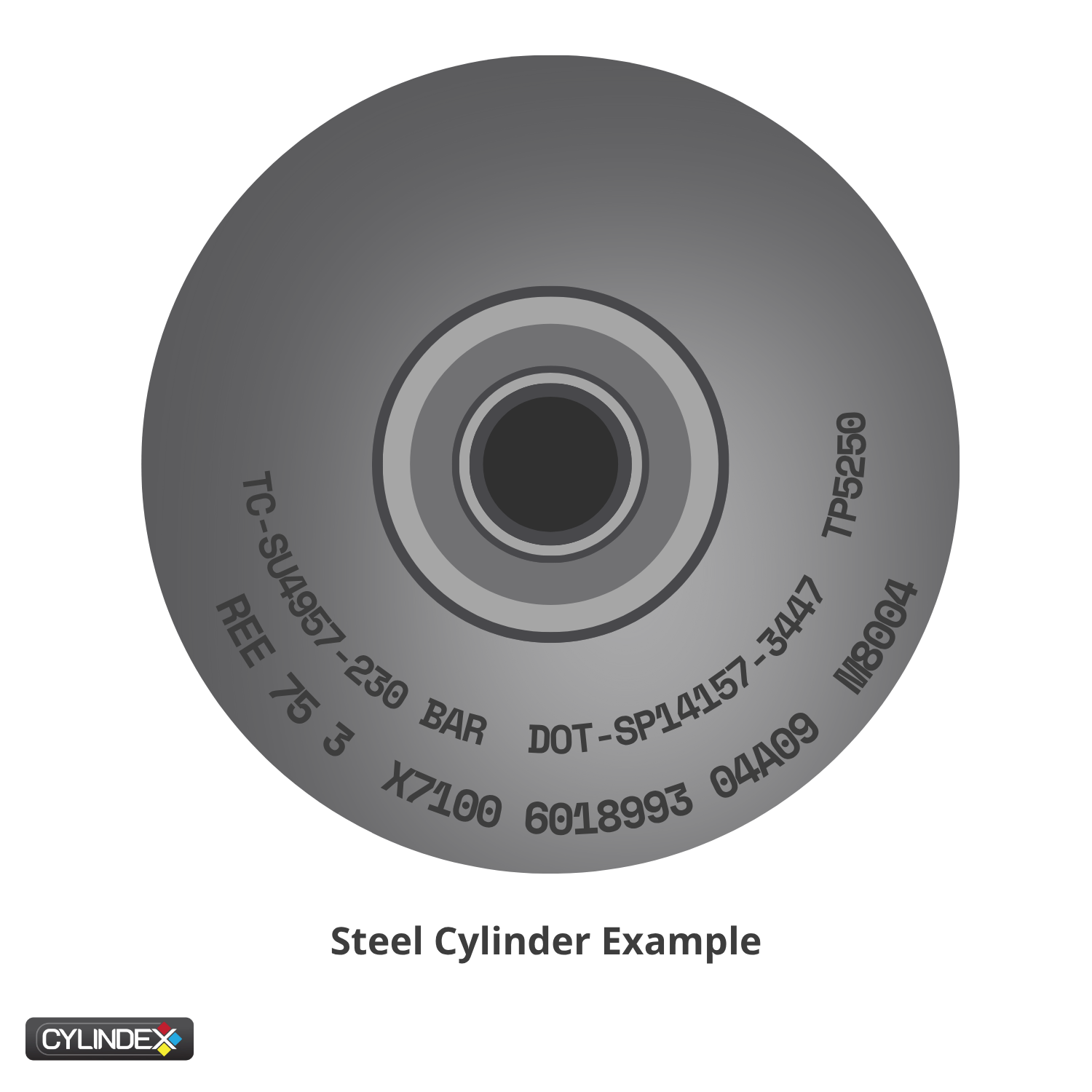
“TC-SU4957-230 BAR”
TC: Transport Canada Compliant
SU4957: Special Permit 4957
230 BAR: Service Pressure in BAR
“DOT-SP14157- 3447”
DOT: Department of Transporation (U.S.A) Compliant
SP14157: Special Permit 14157
3447: Service Pressure in PSI
“TP5250”
Test Pressure 5250PSI
“REE 75 3”
Rejection Elastic Expansion Number 75.3 Cubic Centimeteres
“X7100”
Cylinder Size 71 Cubic Ft
“6018993”
Manufacturer Assigned Serial Number
“04A09”
04: month of Manufacture
A: Mark of Independant Inspector
09: Year of Manufacture
“M8004”
Manufacture Facility Identifier
U.N. High-Pressure Cylinder Markings
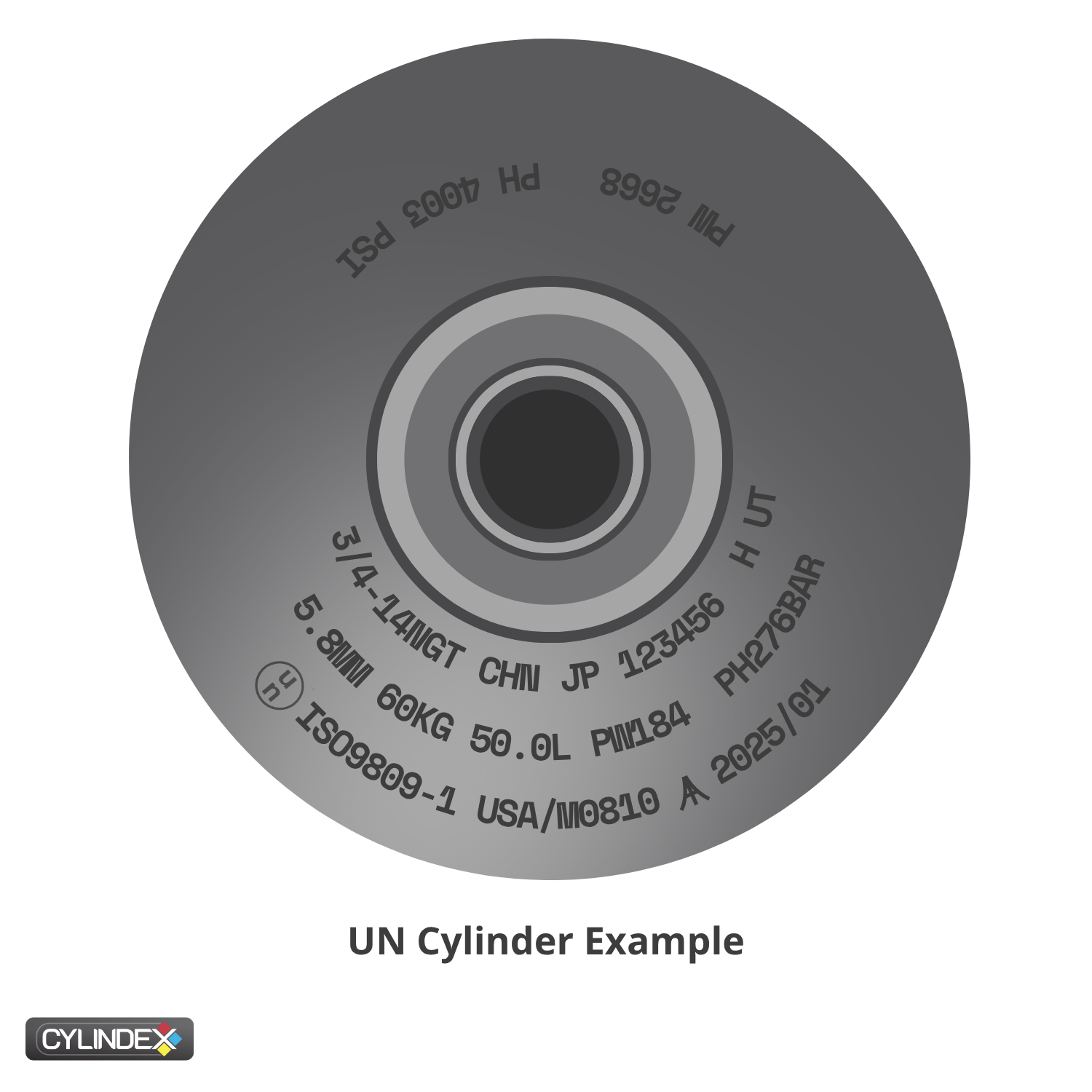
Top Row:
“3/4-14NGT”
Cylinder Thread Identification
“CHN”
Country Code of Manufacture
“JP”
Manufacture Identification
“123456”
Manufacturer Assigned Serial Number
“H”
Hydrogen Compatible (Optional)
“UT”
Stamp For Nondestructive Testing
Middle Row:
“5.8MM”
Minimum Wall Thickness
“60KG”
Weight When Empty
“50.0L”
Water Capacity
“PW184”
Service Pressure 184 BAR
“PH276BAR”
Test Pressure 276 BAR
“PW 2668”
Service Pressure 2668 PSI
“PH 4003 PSI”
Test Pressure 4003 PSI
Bottom Row:
“UN”
United Nations Compliant Stamp
“ISO9809-1”
International Organization of Standardization Compliance
“USA/M0810”
USA: Country of Approval
M0810: Approval Number
“A”
Independant Inspector Mark
“2025/01”
2025: Year of Manufacture
01: Month of Manufacture
The United Nations has established standards for the safe transportation of hazardous materials, including high-pressure compressed gases. These standards cover the manufacture, approval, filling, and use of high-pressure cylinders and receptacles. To ensure a cylinder has met these standards, various numbers and markings are permanently stamped or attached to high-pressure cylinders as part of both the manufacturing and requalification processes. Countries such as the United States and Canada have incorporated UN standards into their own regulations. The degree to which a country incorporates UN safety standards varies: in some cases, specific national stamps are required, while in others, compliance with UN criteria is sufficient.
For example, in the United States, the Pipeline and Hazardous Materials Safety Administration (PHMSA) has incorporated UN standards so that international shippers may use either Department of Transportation (DOT) markings or UN markings for high-pressure cylinders. However, for a cylinder to be used and transported within the U.S.—not merely shipped to and from—it must also carry the country stamp “U.S.A” to demonstrate compliance with PHMSA standards for high-pressure cylinders. This illustrates the nuances and variability of cylinder marking regulations. It is crucial to understand the specific requirements that apply under a given country’s regulations.
The UN/ISO markings required on a cylinder for its safe use will be stamped into the crown of the cylinder in three lines. The first line of markings, located closest to the valve, begins with the thread type ID, which indicates the thread standard required for certain gases and uses. Next is the country of manufacture, typically shown as a three-letter stamp, though this is not necessarily the country where the cylinder may be legally used. The country of manufacturer stamp is followed by the manufacturer’s identification mark and the serial number assigned by the manufacturer. Some gases, such as hydrogen, require cylinders to meet specific standards, and in these cases the letter “H” or another designated stamp specific to the gas in question will follow the serial number. Not all gases require such markings and not all cylinders will have a gas compatibility marking. The final marking on the first line is “UT,” which indicates that the cylinder underwent an ultrasonic test.
The second line of markings begins with the minimum wall thickness for safe use of the cylinder. This is followed by the empty weight of the cylinder. Next is the water capacity of the cylinder. All three of these measurement stamps will be in metric units for a UN/ISO approved cylinder. Following those markings is the service pressure or working pressure, identified by the letters “PW” followed by the pressure in BAR. After the service pressure is the test pressure, identified by the letters “PH” and the pressure in BAR. The working and test pressures may also be duplicated on the opposite side of the crown.
The third line of markings starts with the official UN stamp, followed by the ISO standard the cylinder conforms to. After the ISO standard, the cylinder will display the country of approval stamp—meaning the country where the cylinder is authorized for use and transportation—paired with the approval number. Next is the independent inspector’s identification mark, and finally, the inspection date. On UN cylinders, this date is formatted with the four-digit year followed by the two-digit month.
The ability to identify required UN numbers and markings on high-pressure cylinders provides essential foundational knowledge. Many countries adopt UN standards directly to ensure cylinder safety. For those with national variations, most are derived from or closely aligned with UN standards.